MoreExam
1. Question Content...
EXPLANATION
Answer: X - EXPLANATION Content.
Question1: What requires configuration of both a key store and a trust store for an HTTP Listener?
Question2: What aspects of a CI/CD pipeline for Mute applications can be automated using MuleSoft-provided Maven plugins?
Question3: In a Mule Application, a flow contains two (2) JMS consume operations that are used to connect to a JMS broker and consume messages from two(2) JMS destination. The Mule application then joins the two JMS messages together.The JMS broker does not implement high availability (HA) and periodically experiences scheduled outages of upto 10 mins for routine maintenance.What is the most idiomatic (used for its intented purpose) way to build the mule flow so it can bestrecover from the expected outages?
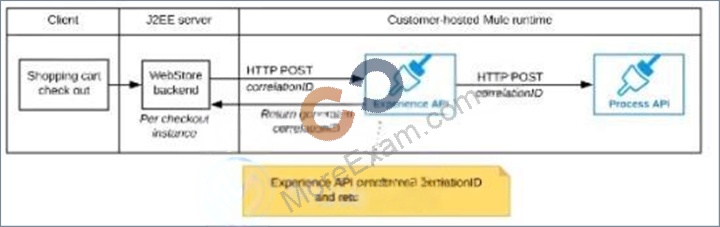
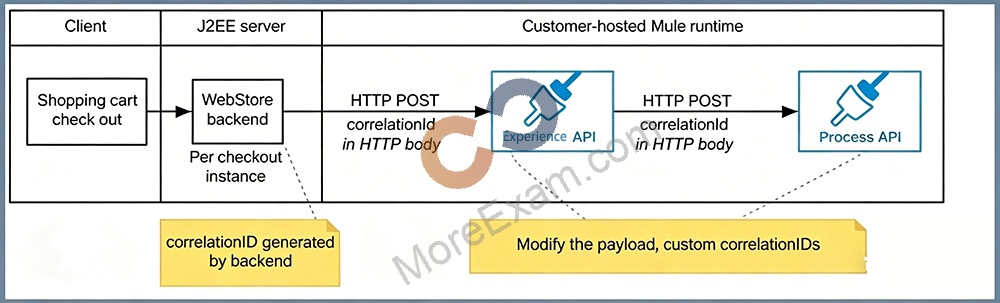
Question4: Refer to the exhibit.Ashopping cart checkout process consists of a web store backend sending a sequence of API invocations to an Experience API, which in turn invokes a Process API. All API invocations are over HTTPS POST. The Java web store backend executes in a Java EE application server, while all API implementations are Mule applications executing in a customer -hosted Mule runtime.End-to-end correlation of all HTTP requests and responses belonging to each individual checkout Instance is required. This is to be done througha common correlation ID, so that all log entries written by the web store backend, Experience API implementation, and Process API implementation include the same correlation ID for all requests and responses belonging to the same checkout instance.What is the most efficient way (using the least amount of custom coding or configuration) for the web store backend and the implementations of the Experience API and Process API to participate in end-to-end correlation of the API invocations for each checkout instance?A)The web store backend, being a Java EE application, automatically makes use of the thread-local correlation ID generated by the Java EE application server and automatically transmits that to the Experience API using HTTP-standard headers No special code or configuration is included in the web store backend, Experience API, and Process API implementations to generate and manage the correlation IDB)The web store backend generates a new correlation ID value at the start of checkout and sets it on the X-CORRELATlON-lt HTTP request header In each API invocation belonging to that checkout No special code or configuration is included in the Experience API and Process API implementations to generate and manage the correlation IDC)The Experience API implementation generates a correlation ID for each incoming HTTP request and passes it to the web store backend in the HTTP response, which includes it in all subsequent API invocations to the Experience API.The Experience API implementation must be coded to also propagate the correlation ID to the Process API in a suitable HTTP request headerD)The web store backend sends a correlation ID value in the HTTP request body In the way required by the Experience API The Experience API and Process APIimplementations must be coded to receive the custom correlation ID In the HTTP requests and propagate It in suitable HTTP request headers
Question5: An organizationis designing a mule application to support an all or nothing transaction between serval database operations and some other connectors so that they all roll back if there is a problem with any of the connectors Besides the database connector , whatother connector can be used in the transaction.
Question6: An integration Mute application consumes and processes a list of rows from a CSV file. Each row must be read from the CSV file, validated, and the row data sent to a JMS queue, in the exact order as in the CSV file.If any processing step for a row falls, then a log entry must be written for that row, but processing of other rows must not be affected.What combination of Mute components is most idiomatic (used according to their intended purpose) when Implementing the above requirements?
Question7: Refer to the exhibit.A Mule application is being designed to expose a SOAP web service to its clients.What language is typically used inside the web service's interface definition to define the data structures that the web service Is expected to exchange with its clients?
Question8: In Anypoint Platform, a company wants to configure multiple identity providers(Idps) for various lines of business (LOBs) Multiple business groups and environments have been defined for the these LOBs. What Anypoint Platform feature can use multiple Idps access the company's business groups and environment?
Question9: An organization is creating a set of new services that are critical for their business. The project team prefers using REST for all services but iswilling to use SOAP with common WS-" standards if a particular service requires it.What requirement would drive the team to use SOAP/WS-* for a particular service?
Question10: What aspect of logging is only possible for Mule applications deployed to customer-hosted Mule runtimes, but NOT for Mule applications deployed to CloudHub?
Question11: A Mule application is synchronizing customer data between two different database systems.What is the main benefit of using XA transaction over local transactions to synchronize these two database system?
Question12: A Mule application contains a Batch Job with two Batch Steps (Batch_Step_l and Batch_Step_2). A payload with 1000 records is received by the Batch Job.How many threads are used by the Batch Job to process records, and how does each Batch Step process records within the Batch Job?
Question13: An organization is sizing an Anypoint VPC to extend their internal network to Cloudhub.For this sizing calculation, the organization assumes 150 Mule applications will be deployed among three(3) productionenvironments and will use Cloudhub's default zero-downtime feature. Each Mule application is expected to be configured with two(2) Cloudhub workers.This is expected to result in several Mule application deployments per hour.
Question14: Refer to the exhibit.An organization is sizing an AnypointVPC for the non-production deployments of those Mule applications that connect to the organization's on-premises systems. This applies to approx. 60 Mule applications. Each application is deployed to two CloudHub i workers. The organization currently has three non-production environments (DEV, SIT and UAT) that share this VPC. The AWS region of the VPC has two AZs.The organization has a very mature DevOps approach which automatically progresses each application through all non-production environments before automatically deploying to production. This process results in several Mule application deployments per hour, using CloudHub's normal zero-downtime deployment feature.What is a CIDR block for this VPC that results in the smallest usable private IP address range?
Question15: A team would like to create a project skeleton that developers can use as a starting point when creating API Implementations with Anypoint Studio. This skeleton should help drive consistent use of best practices within the team.What type of Anypoint Exchange artifact(s) should be added to Anypoint Exchange to publish the project skeleton?
Question16: 49 of A popular retailer is designing a public API for its numerous business partners. Each business partner will invoke the API at the URL 58. https://api.acme.com/partnefs/vl. The API implementation is estimated to require deployment to 5 CloudHub workers.The retailer has obtained a public X.509 certificate for the name apl.acme.com, signed by a reputable CA, to be used as the server certificate.Where and how should the X.509 certificate and Mule applications be used to configure load balancing among the 5 CloudHub workers, and what DNS entries should be configured in order for the retailer to support its numerous business partners?
Question17: An organization's governance process requires project teams to get formal approval from all key stakeholders for all new Integration design specifications. An integration Mule application Is being designed that interacts with various backend systems. The Mule application will be created using Anypoint Design Center or Anypoint Studio and will then be deployed to a customer-hosted runtime.What key elements should be included in the integration design specification when requesting approval for this Mule application?
Question18: A Mule application name Pub uses a persistence object store. The Pub Mule application is deployed to Cloudhub and it configured to use Object Store v2.Another Muleapplication name sub is being developed to retrieve values from the Pub Mule application persistence object Store and will also be deployed to cloudhub.What is the most direct way for the Sub Mule application to retrieve values from the Pub Mule application persistence object store with the least latency?
Question19: An organization is designing the following two Mule applications that must share data via a common persistent object store instance:- Mule application P will be deployed within their on-premises datacenter.- Mule application C will run on CloudHub in an Anypoint VPC.The object store implementation used by CloudHub is the Anypoint Object Store v2 (OSv2).what type of object store(s) should be used, and what design gives both Mule applications access to the same object store instance?
Question20: An API has been unit tested and is ready for integration testing. The API is governed by a Client ID Enforcement policy in all environments.What must the testing team do before they can start integration testing the API in the Staging environment?
Question21: What operation can be performed througha JMX agent enabled in a Mule application?
Question22: What limits if a particular Anypoint Platform user can discover an asset in Anypoint Exchange?
Question23: A set of integration Mule applications, some of which expose APIs, are being created to enable a new business process. Various stakeholders may be impacted by this. These stakeholders are a combination of semi-technical users (who understand basic integration terminology and concepts such as JSON and XML) and technically skilled potential consumers of the Mule applications and APIs.What Is an effective way for the project team responsible for the Mule applications and APIs being built to communicate with these stakeholders using Anypoint Platform and its supplied toolset?
Question24: What is required before an API implemented using the components of Anypoint Platform can be managed and governed (by applying API policies) on Anypoint Platform?
Question25: Refer to the exhibit.One of the backend systems invoked by an API implementation enforces rate limits on the number of requests a particular client can make. Both the backend system and the API implementation are deployed to several non-production environments in addition to production.Rate limiting of the backend system applies to all non-production environments. The production environment, however,does NOT have any rate limiting.What is the most effective approach to conduct performance tests of the API implementation in a staging (non-production) environment?
Question26: An organization has various integrations implemented as Mule applications. Some of these Mule applications are deployed to custom hosted Mule runtimes (on-premises) while others execute in the MuleSoft-hosted runtime plane (CloudHub). To perform the Integra functionality, theseMule applications connect to various backend systems, with multiple applications typically needing to access the backend systems.How can the organization most effectively avoid creating duplicates in each Mule application of the credentials required to access the backend systems?
Question27: A Mule application is deployed to a cluster of two(2) cusomter-hosted Mule runtimes. Currently the node name Alice is the primary node and node named bob is the secondary node. The mule application has a flow that polls a directory on a file system for new files.The primary node Alice fails for an hour and then restarted.After the Alice node completely restarts, from what node are the files polled, and what node is now the primary node for the cluster?
Question28: A Mule application currently writes to twoseparate SQL Server database instances across the internet using a single XA transaction. It is 58. proposed to split this one transaction into two separate non-XA transactions with no other changes to the Mule application.What non-functional requirement can be expected to be negatively affected when implementing this change?